


Corporate tax in Dubai applies to juridical entities (companies) earning taxable profits above AED 375,000, while natural persons are typically exempt from tax on personal real estate investment income. Failure to comply with these requirements can lead to assessment errors, disallowed deductions, and significant Federal Tax Authority (FTA) penalties. Under Federal Decree-Law No. 47 of 2022 on the Taxation of Corporations and Businesses, natural persons and companies are subject to distinct tax treatments based on licensing and turnover. This article clarifies key rules to help property investors, developers, and landlords ensure regulatory compliance and avoid unnecessary tax risks.
Understanding Corporate Tax in Dubai's Real Estate Sector
Corporate tax in Dubai is governed by Federal Decree-Law No. 47 of 2022, which imposes a 9% tax on taxable business profits exceeding AED 375,000. For real estate investors, tax treatment depends on whether income is generated through a company or an individual. Factors such as property type, entity status, licensing, and turnover thresholds are critical in determining the applicable tax rate and liability. To manage this effectively, businesses and investors often utilize specialized Corporate Tax Services to determine the applicable tax rate and identify potential exemptions for natural persons. Cabinet Decision No. 49 of 2023 provides further guidance for property investors to understand their roles, business purpose, and compliance obligations. For a detailed overview, consult the UAE Federal Tax Authority, Cabinet Decision No. 49 of 2023.
Corporate tax in Dubai is governed by Federal Decree-Law No. 47 of 2022, requiring entities with commercial licenses and income above statutory thresholds to comply fully with FTA regulations. To manage this effectively, businesses and investors often utilize specialized Corporate Tax Services to determine the applicable tax rate and identify potential exemptions for natural persons. This ensures that roles and compliance obligations, particularly under Cabinet Decision No. 49 of 2023, are met accurately and efficiently. As part of this compliance framework, timely corporate tax registration and accurate Corporate Tax Return Filing in UAE are essential to meeting ongoing Federal Tax Authority requirements and avoiding penalties.
How Corporate Tax Applies to Real Estate in Dubai?
The tax treatment of real estate activities in Dubai depends on the nature of transactions, the entity conducting the business, and income thresholds. Taxable activities include property development, rental income, and capital gains from sales. Compliance requirements vary according to entity type. Understanding these factors is essential for mitigating financial risks and accurately forecasting tax liabilities. Non-compliance with FTA guidelines may result in retrospective assessments or penalties. The law also distinguishes between natural persons and legal entities, with special provisions applicable to free zone participants. Real estate businesses must maintain proper documentation, register timely, and submit annual tax returns as required.
Taxable Activities in Real Estate
Several real estate business activities attract corporate tax liability for both companies and qualifying individuals. Understanding these triggers is essential to avoid unexpected tax exposure and penalties. Each income source is evaluated for alignment with taxable business activities under FTA criteria. Entities and individuals involved in multiple segments should regularly review their transactions for evolving compliance obligations.
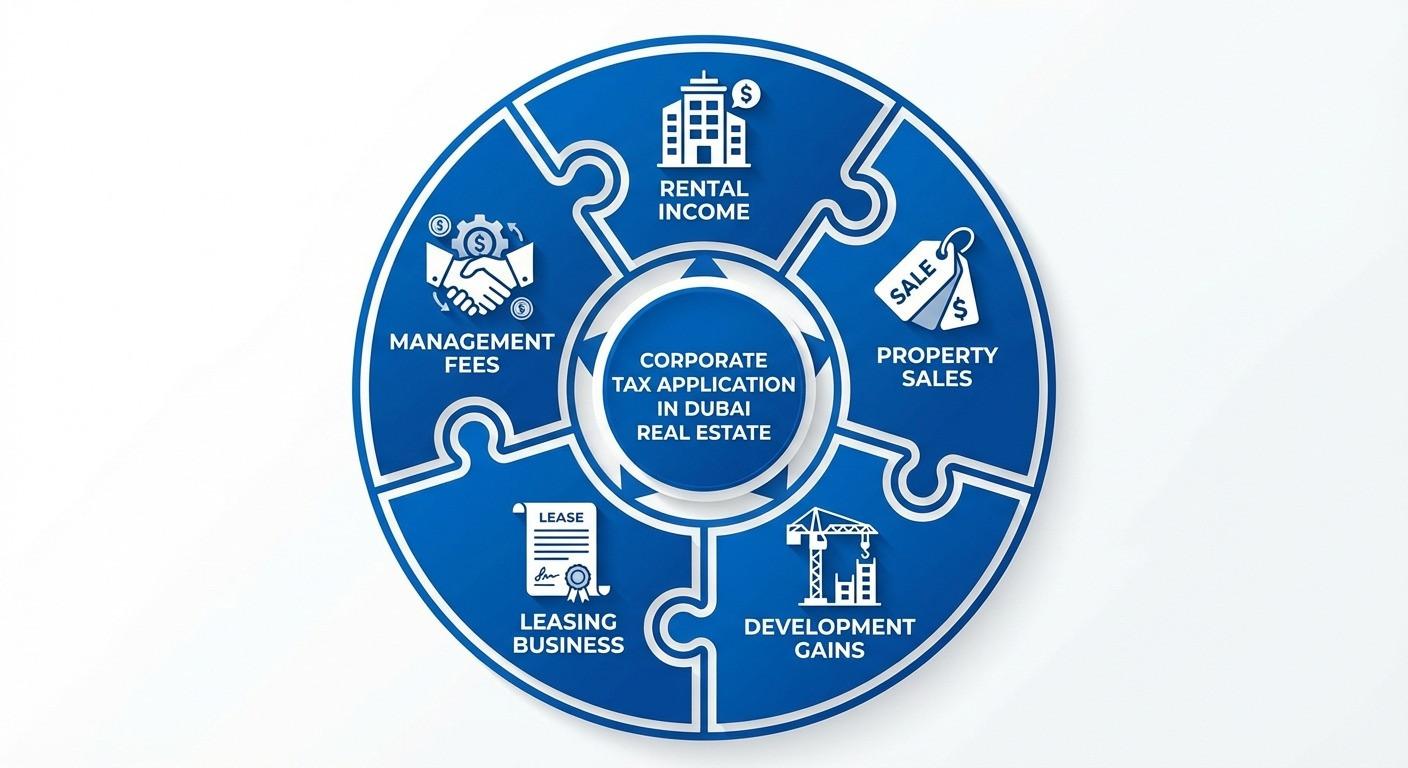
- Rental income from commercial properties: Rental income from commercial real estate is subject to Corporate Tax for companies. However, for natural persons, income from leasing commercial property is generally excluded from Corporate Tax, provided it is a personal investment and not conducted through a business license.
- Profits from property sales linked to business activities: Gains from real estate asset sales conducted as part of ongoing business activities may be taxable as business income.
- Gains from real estate development projects: Income derived from property development, including construction and renovation, is taxable if conducted by a licensed entity or qualifying individual.
- Leasing and operating real estate as a business: Entities managing properties for lease or sublease, particularly with commercial licenses, are subject to corporate tax obligations.
- Property management fees and related service income: Income from providing property management or real estate agency services is included as taxable business income.
Corporate Tax Rates and Thresholds
The standard corporate tax rate is 9% on taxable business profits exceeding AED 375,000 in the financial year. Companies and individuals with qualifying business income must monitor turnover against these thresholds. Taxable Income below the AED 375,000 threshold is subject to a 0% rate. Accurate revenue tracking prevents unregistered taxable activity.
Differential Treatment: Natural Persons vs Legal Entities
Corporate tax liability depends not only on profit amounts but also on the investor’s legal status and activity licensing. The law applies distinct thresholds and exemptions for natural persons compared to registered corporations. This approach ensures that only business-driven activities are taxed, while typical personal investments remain exempt within defined limits.
- Natural persons generally exempt below AED 1 million turnover if no commercial license: Individuals with real estate income who do not hold a commercial license and have turnover below AED 1 million are generally exempt from corporate tax.
- Companies taxed on profits exceeding AED 375,000: Registered companies pay 9% tax on profits above this threshold, irrespective of activity type.
- Free zone entities may have special 0% tax treatment: Qualifying free zone entities engaged in eligible activities may benefit from a 0% tax rate according to regulatory provisions.
- Licensing status directly influences liability: Commercial real estate licenses bring all activities under the taxable scope, even for natural persons.
- Turnover measurement is on an aggregate basis: Turnover measurement is on an aggregate basis; however, income from wages, personal investments, and real estate investments are strictly excluded from this calculation for natural persons.
Real Estate Income for Natural Persons and Tax Treatment
Individuals investing in Dubai real estate are subject to unique corporate tax rules. The legislation differentiates between passive personal investments and business activities. Income from residential or non-commercial properties typically falls outside corporate tax unless business conditions apply. Taxability depends on turnover and licensing. Natural persons conducting commercial real estate operations must register and comply with tax requirements. Evaluating licensing, activity volume, and revenue is critical to avoid unexpected assessments and ensure compliance.
Real Estate Investment by Natural Persons
Natural persons invest in real estate through direct ownership or joint ventures. The law distinguishes passive investments from ongoing business activities. This distinction determines when tax registration and filings are mandatory.
- Investing in residential or non-commercial properties: Passive ownership without a business license is generally outside corporate tax scope.
- Income exempt if no commercial license and turnover below AED 1 million: Individuals without commercial licenses with turnover less than AED 1 million benefit from exemption.
- Tax liability triggered by business licensing or exceeding turnover threshold: Commercial real estate business registration or turnover above AED 1 million mandates inclusion in the tax regime.
- Co-ownership arrangements may be subject to special rules: Joint property ownership within business structures may require additional compliance.
Taxable Rental Income and Capital Gains
Rental income and gains from property sales by natural persons are taxable only if the activity is commercial or turnover exceeds AED 1 million. Passive residential investments generally remain exempt unless thresholds are exceeded. Assessment of rental income and capital gains, particularly as portfolios grow, is necessary. Crossing licensing or turnover criteria requires timely corporate tax registration for natural persons.
Assessing Tax Liability for Natural Persons
Individual investors must monitor licensing, activity volume, and turnover thresholds to determine tax status. Licensing triggers immediate tax obligations. Turnover exceeding AED 1 million also mandates registration. Compliance includes registration, filing returns, and maintaining documentation as per FTA rules. The FTA may revise definitions of taxable business activity, so ongoing assessment is necessary.
- Licensing as a commercial real estate business: Possession of a commercial license subjects activities to corporate tax requirements.
- Turnover exceeding AED 1 million: from other business activities (e.g., trading, services) requires registration, but real estate investment income is excluded from this calculation.
- Registration and compliance requirements: Qualifying individuals must register, file returns, and maintain records according to FTA standards.
- Periodic review of activity definitions: Updates by the FTA may affect liability for certain investment types.
Corporate Entities and Real Estate Development
Companies involved in real estate development and property holding in Dubai are fully subject to corporate tax regulations. Income from construction, leasing, asset sales, and management fees comprises taxable profits under FTA rules. Accurate expense management and documentation are critical to maximize allowable deductions and reduce taxable income. Effective tax planning requires the identification of legitimate business costs and the consistent application of accepted accounting standards. Failure in record-keeping or reporting often results in compliance failures, audit adjustments, and unexpected tax liabilities. Adherence to prescribed standards sustains both profitability and regulatory compliance.
Tax Impact on Property Development Companies
For corporate entities, profits from real estate activities, including development, construction, leasing, management, and asset sales, constitute taxable income. Companies must register for corporate tax and submit accurate, timely tax returns. Regulatory oversight intensifies for high-value transactions and complex structures. Firms must differentiate capital gains, operating profits, and intercompany transfers when preparing tax accounts. Complex development models or off-plan sales may require advanced documentation and specialist compliance reviews.
Treatment of Expenses and Deductions
Proper expense deductibility is essential for tax-efficient operations. Corporate taxpayers must systematically identify, document, and report all qualifying real estate costs. Effective deduction management reduces tax liabilities, improves cash flow, and supports audit defense.
- Allowable deductions for construction and development costs: Direct construction costs and development fees are deductible from taxable income.
- Financing and interest expenses: Interest on loans for property acquisition or development is deductible if solely for business purposes.
- Depreciation of assets based on accepted accounting standards: Annual depreciation of buildings and infrastructure, following accounting standards, reduces taxable profit.
- Repair and maintenance expenses: Repair and maintenance of rental assets are deductible annually according to FTA guidelines.
- Property management and service costs: Fees for external property and facility management qualify as deductions.
- Professional advisory and compliance costs: Legal, audit, and tax advisory expenses necessary for business operations are deductible.
- Marketing and operating expenses: Marketing and property management costs for commercial portfolios are typically deductible within FTA limits.
Accounting for Revenue and Costs
Accurate accounting requires proper recognition of income and expenses, fundamental to corporate tax compliance. All real estate revenue must conform to relevant accounting standards and FTA guidelines. Periodic reconciliation of income, costs, and deductions prevents compliance issues and penalties. Strong internal controls and transparent documentation facilitate timely submissions and audit readiness.
Key Tax Considerations for Dubai Real Estate Investors
Real estate investors in Dubai face multifaceted tax obligations involving rental income, property sales, qualifying deductions, and filing requirements. Understanding income classification, allowable deductions, and supporting documentation is critical for managing tax risks and sustaining profitability. Timely compliance, proactive record keeping, and regular professional advice are necessary to address regulatory changes. Attention to deadlines and FTA regulations prevents unnecessary assessments, late filing penalties, and loss of deductibility.
Treatment of Rental Income
Rental income significantly contributes to taxable profits for companies and qualifying individuals in real estate. Proper reporting and substantiation are essential for compliance and deduction maximization. Investors must distinguish between commercial and non-commercial rentals and maintain comprehensive documentation as required by the FTA.
- Rental income from commercial properties is subject to 9% tax beyond thresholds: Income from leasing commercial properties is taxable at 9% after crossing statutory thresholds.
- Non-commercial rentals are generally taxable under corporate tax if linked to business activity: Leasing activities resembling business operations may fall under tax rules.
- Documentation and reporting requirements to FTA: All rental agreements, tenant payments, and receipts must be documented and reported following FTA standards.
- On-time inclusion in annual tax returns: Rental income must be reported in annual tax filings by deadlines to avoid late submission penalties. See our rental income tax insights.
Taxation of Property Sales
Capital gains from property sales are included in taxable profits for companies and licensed individuals. Certain personal investments and qualifying free zone entities may be exempt if conditions are met. Accurate classification and documentation of sales prevent double taxation and preserve entitled exemptions. Cross-border transactions or complex ownership require expert evaluation to determine taxable gains.
Allowable Deductions and Expenses
Investors may reduce taxable profits by claiming all allowed deductions related to property upkeep, financing, and management. Detailed record-keeping and compliance with regulatory standards optimize deductions and mitigate unexpected liabilities.
- Maintenance and repair costs: Regular property maintenance expenses qualify as allowable deductions, decreasing tax liability.
- Interest on loans related to real estate: Loan interest incurred exclusively for property activities is deductible with appropriate support.
- Depreciation expenses as per accounting standards: Depreciation following accepted accounting standards can be applied annually to eligible assets.
- Professional service fees: Tax, legal, and audit fees related to real estate activities are generally deductible.
- Service charges and management fees: Building management and third-party administration fees reduce taxable business income.
Compliance and Filing Responsibilities
All qualifying real estate investors and companies must register for corporate tax, submit required returns, and maintain transaction evidence as mandated by the FTA. Non-compliance with compliance and filing responsibilities can incur late filing penalties or regulatory inquiries. Implementing reliable systems, automation, and regular professional audits supports effective obligation management and audit readiness.
Conclusion
Correctly applying the UAE corporate tax regime to real estate activities ensures that investors secure both operational efficiency and regulatory safety. Strategic structuring, identification of exemptions, and timely compliance offer sustainable benefits in a sector where tax exposure can materially affect profit projections. By choosing Reyson Badger, investors benefit from a client-first approach, deep domain expertise, full transparency, and commitment to long-term growth through precision and regulatory insight.
Frequently Asked Questions(FAQs)
1. Is real estate income for natural persons subject to corporate tax in the UAE?
Real estate income for natural persons is subject to corporate tax only if it exceeds the AED 1 million turnover threshold or the activity is conducted under a commercial license.
2. What is the corporate tax rate for real estate profits in Dubai?
The corporate tax rate is 9% on taxable business profits above AED 375,000 in Dubai under Federal Decree-Law No. 47 of 2022.
3. When must a natural person register for corporate tax in the UAE?
A natural person must register for corporate tax upon reaching an annual turnover of AED 1 million from business activities or obtaining a commercial license.
4. How does free zone status affect corporate tax on real estate income?
Qualifying free zone entities involved in approved activities may benefit from a 0% corporate tax rate on eligible real estate income subject to FTA conditions.
5. Are there tax exemptions for non-commercial properties in the UAE real estate?
Income from non-commercial residential property owned by individuals without a commercial license and below the AED 1 million turnover threshold is generally exempt from corporate tax.