
Top 20 Corporate Tax Consultants in UAE
19-Jan-2026
Corporate Tax in UAE
The United Arab Emirates (UAE) implemented a federal Corporate Tax (CT) system in June 2023. This new regime aims to diversify the country's revenue streams and position it as a more competitive global business hub. This guide will provide you with a comprehensive overview of the key aspects of UAE Corporate Tax.
Objectives of Corporate Tax
The UAE introduced corporate tax to:
- Strengthen its position as a global business hub.
- Support economic growth and strategic transformation.
- Ensure compliance with international tax transparency standards.
- Prevent harmful tax practices and promote fair competition.
Who is Subject to UAE Corporate Tax?
The Corporate Tax in Dubai applies to most businesses and commercial activities conducted within the UAE, with a few exceptions. Here's a breakdown of who is subject to the tax:
Individuals do not pay corporate tax on their salary or employment income. The corporate tax regime applies to individuals only when they carry on a business activity (e.g. sole proprietorship, freelancing) and are classified as taxable persons. In such cases, business profits are taxed under the same brackets: 0% up to AED 375,000, 9% above that (unless otherwise exempt).
1. Companies & Legal Entities Required to Pay Corporate Tax in Dubai, UAE
a) UAE-Based Companies
Mainland Companies: All businesses registered in the UAE (except exempt entities).
Free Zone Companies:
- Subject to 0% CT if they qualify as a Qualifying Free Zone Person (QFZP).
- Taxed at 9% if they do not meet QFZP conditions or earn mainland-sourced income.
b) Foreign Companies with UAE Presence
Businesses with a Permanent Establishment (PE) in the UAE (e.g., branch offices, physical offices).
Companies earning UAE-sourced income (e.g., from real estate, services, or contracts performed in the UAE).
c) Tax Groups
Companies under 75% common ownership can form a tax group and file a consolidated return.
2. Individuals Subject to Corporate Tax in UAE
Self-employed professionals & freelancers (if annual business income exceeds AED 375,000).
Sole proprietorships & individual business owners engaged in commercial activities.
3. Exempt Entities (Do Not Pay Corporate Tax)
The following are generally exempt from UAE corporate tax:
- Government & semi-government entities
- Public benefit organizations & charities (approved by the FTA)
- Pension & social security funds
- Qualifying investment funds
- Extractive businesses (oil & gas, subject to emirate-level taxes)
- Non-resident businesses with no UAE-sourced income or PE
4. Special Cases & Conditions
a) Free Zone Businesses (0% Tax Under Conditions)
To benefit from 0% CT, a free zone company must:
- Conduct qualifying activities (e.g., manufacturing, trading, logistics).
- Maintain adequate substance in the UAE (office, employees, operations).
- Not earn mainland UAE-sourced income (unless permitted).
- Comply with transfer pricing and anti-abuse rules.
b) Non-Resident Businesses (Only Taxed on UAE Income)
Foreign companies without a UAE presence are only taxed on:
- Income from a UAE Permanent Establishment (PE).
- UAE-sourced income (e.g., real estate, service contracts).
Key Features of UAE Corporate Tax
Tax Rate
The UAE CT features a tiered system with the following rates:
0% : Applicable to taxable income not exceeding AED 375,000 (approx. USD 102,100). This offers relief to small businesses.
9% : Standard rate applicable to taxable income exceeding AED 375,000.
15% : Applies to large Multinational Enterprises (MNEs) meeting specific criteria related to group revenue.
Important Considerations
- Small Business Relief : Businesses with taxable income below AED 375,000 qualify for a 0% tax rate.
- Free Zone Companies : The CT treatment for free zone companies depends on their specific free zone and the type of income earned. Qualifying free zone persons earning qualifying income are generally exempt from CT. However, non-qualifying income earned by them is subject to the 9% tax rate, in line with the applicable Corporate Tax in Dubai and other emirates..
- Qualifying Free Zone Person : A Qualifying Free Zone Person (QFZP) is a Free Zone Person that meets specific criteria, such as deriving Qualifying Income, maintaining adequate substance in the Free Zone, and not electing to be subject to the standard Corporate Tax rules and rates. The Free Zone Person must also comply with the arm’s length principle, maintain appropriate Transfer Pricing documentation, and audited Financial Statements
- Qualifying Income : Qualifying Income is income derived by a Qualifying Free Zone Person (QFZP) that is eligible for a 0% Corporate Tax rate under specific conditions. This includes income from transactions with other Free Zone Persons who are the Beneficial Recipients, transactions related to Qualifying Activities, income from Qualifying Intellectual Property, and other income, provided the QFZP meets the de minimis requirements.
- Transfer Pricing : UAE CT Law incorporates transfer pricing rules, which aim to ensure transactions between related parties are conducted at arm's length (fair market value).
- Double Taxation Agreements : The UAE has existing Double Taxation Agreements (DTAs) with many countries. These DTAs help avoid double taxation on the same income earned in both countries.
Register For Corporate Tax in UAE
According to Decision No. 3 of 2024 from the Federal Tax Authority, starting from March 1, 2024, the FTA has set forth deadlines for all businesses and taxable individuals to enrol. This enrolment pertains to all businesses (legal entities) possessing a trade license. The deadlines are staggered to allow the Federal Tax Authority (FTA) enough time to properly evaluate applicants.
Under FTA Decision No. 3 of 2024 (effective 1 March 2024), registration deadlines vary by the month of licence issuance.
- For licences issued before 1 March 2024, deadlines are set according to the month of issuance — for example, licences issued in January–February → register by 31 May 2024; March–April → register by 30 June 2024, and so on.
- For businesses licensed on or after 1 March 2024, registration must be completed within 3 months of licence issuance.
- Entities that fail to register by their deadline are subject to an administrative penalty of AED 10,000.
Regardless of the year of issuance of the license, the date of license issuance is taken into consideration.
Here are the deadlines for submitting a Corporate Tax registration application:
| License Issuance Period | Deadline for Tax Registration Application |
|---|---|
| Before 1 March 2024 | 31 May 2024 (for May/June 2024 deadlines) |
| Between 1 March 2024 and 31 December 2024 | Within 3 months of licence issuance |
| On or after 1 January 2025 | Within 3 months of licence issuance |
Notes:
- Businesses operating before 1 March 2024 had to register by 31 May 2024 (if their turnover exceeded AED 1 million in 2023).
- New businesses (licences issued after 1 March 2024) must register within 3 months of incorporation or licence issuance.
- The Federal Tax Authority (FTA) may adjust deadlines, so it's best to check the latest updates on the FTA website.
Businesses failing to submit their Corporate Tax registration applications within the specified timelines will face an administrative penalty of AED 10,000 for late registration.
Steps to Corporate Tax Filing in UAE
Filing Corporate Tax in Dubai, UAE, is a structured and straightforward process designed to ensure compliance with Federal Decree-Law No. 47 of 2022. Here’s how businesses can file their Corporate Tax returns:
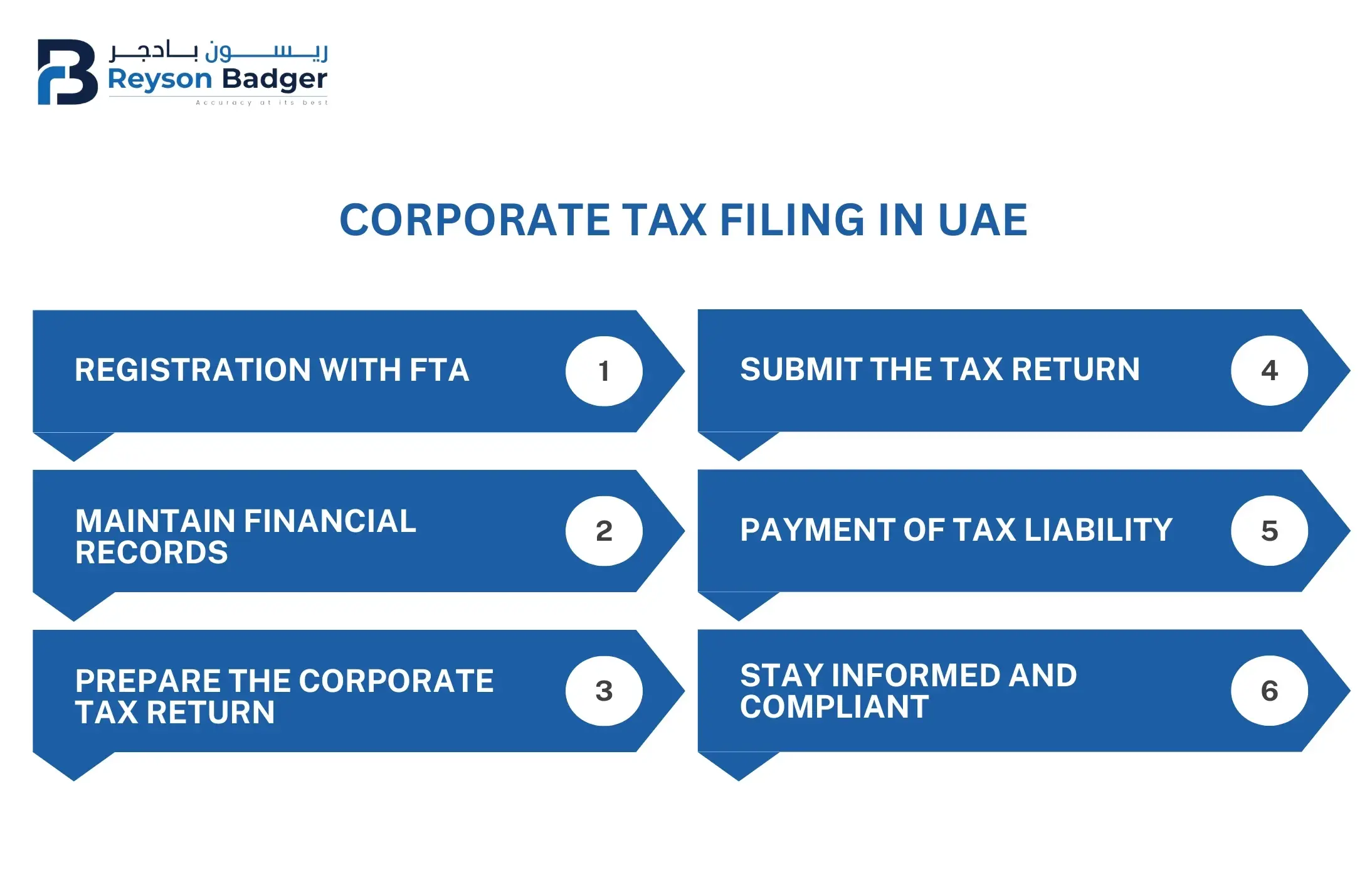
Step 1: Registration with FTA
- All taxable persons must register on the Federal Tax Authority’s (FTA) EmaraTax platform.
- Obtain a unique Tax Registration Number (TRN).
Step 2: Maintain Financial Records
- Maintain accurate financial records and compute taxable income.
- Identify eligible deductions, exemptions, and reliefs (e.g., small business relief, group transfers).
Step 3: Prepare the Corporate Tax Return
- Calculate your taxable income by adjusting your accounting profit for any exemptions, reliefs, or deductions as specified by the UAE Corporate Tax Law.
- The UAE imposes a 0% tax rate on taxable income up to AED 375,000 and a 9% rate on taxable income exceeding this threshold.
Step 4: Submit the Tax Return
- Submit your corporate tax return electronically through the EmaraTax portal within 9 months of the financial year’s end.
- The UAE requires that all corporate tax returns be filed online via the EmaraTax portal. The system is dynamic, presenting tailored questions and schedules based on the taxpayer's specific circumstances related to Corporate Tax in Dubai.
Step 5: Payment of Tax Liability
- Determine your tax liability based on the applicable rates and ensure payment is made by the specified deadline to avoid penalties.
Step 6: Stay Informed and Compliant
- Regularly consult the FTA's official communications and guidelines to stay updated on any changes in tax laws or filing procedures.
- Consider seeking advice from tax professionals to ensure full compliance and to address any complexities specific to your business operations.
Corporate Tax in Dubai, UAE
The UAE's corporate tax rules are new and evolving, so it's smart to have a well-thought-out plan from the start. This will make it easier to adjust to any future changes. Since the tax landscape is constantly shifting, it's important to regularly review your strategy and get advice from UAE tax experts. By being proactive and staying informed, your business can handle the complexities of UAE corporate taxes. Reyson Badger is here to expertly guide your organization through all aspects of UAE corporate tax compliance and optimization – both now and in the years ahead.
FAQ
Corporate Tax in UAE
The UAE introduced a federal corporate tax starting 1 June 2023. Businesses pay 0% tax on profits up to AED 375,000 and 9% on profits above that amount. The law applies to mainland companies and eligible free zone businesses, with certain exemptions.
Some entities do not pay UAE corporate tax. These include government and government-controlled entities, natural resource businesses, qualifying public benefit organizations, and approved investment funds, as long as they meet conditions set by the Federal Tax Authority.
If a business fails to register, file returns, or pay UAE corporate tax on time, penalties may apply. These include administrative fines, late filing penalties, and charges on unpaid tax. The FTA may offer relief initiatives, but timely compliance is still required.
Free zone companies can benefit from 0% corporate tax on qualifying income if they meet the conditions of a Qualifying Free Zone Person. Any non-qualifying income is taxed at 9%, and businesses must follow substance and reporting rules.
To calculate UAE corporate tax, start with your business profits from financial statements. Apply allowable deductions and exemptions. Profits up to AED 375,000 are taxed at 0%, while profits above that are taxed at 9%, unless free zone benefits apply.
Qualifying Free Zone Income is income earned by an eligible free zone company from approved activities. This income is taxed at 0%, provided the business meets substance requirements, follows transfer pricing rules, and qualifies as a Qualifying Free Zone Person.







Latest Blogs

22
Jan
Accounts Outsourcing Services in Dubai: What Every Business Owner Should Know
Accounts Outsourcing Services in Dubai cover essential finance functions through a structured and professional workflow, compliant, and financially organized.
READ MORE →
19
Jan
VAT Impact on Company Profit in UAE: Key Factors Businesses Must Understand
Explore how VAT impacts company profit in the UAE, including compliance costs, pricing strategies, and the role of professional VAT services for businesses.
READ MORE →
19
Jan
Understanding VAT Refund Rules for Tourists in UAE Under FTA Guidelines
This guide explains VAT refund rules for tourists in the UAE, including eligibility, qualifying purchases, refund process, and key FTA guidelines to claim VAT refund in UAE.
READ MORE →
22
Jan
Why AML Checks Are More Important Than Ever in 2026?
Learn why AML compliance is vital in 2026. Avoid fines, protect your business, and meet new regulatory standards with strong AML checks.
READ MORE →
23
Jan
VAT Registration Threshold in UAE: Requirements, Calculation, and Compliance
READ MORE →
22
Jan
Amendment of the United Arab Emirates (UAE) VAT Decree-Law from 1st January 2026
UAE VAT Decree-Law amendments effective 2026 explained, including reverse charge updates, refund time limits, and enhanced FTA authority.
READ MORE →
19
Jan
Accounting Services in Dubai: A Practical Guide for Growing Companies
Accounting services in UAE, businesses gain clarity, confidence, and control over their finances allowing them to focus on what matters most: building and scaling their business in the UAE's competitive market.
READ MORE →
23
Jan
Corporate Tax Advance Pricing Agreements in the UAE
Advance Pricing Agreements (APAs) in the UAE help businesses obtain certainty on transfer pricing methods under the Corporate Tax regime. Learn how APAs work, eligibility criteria, benefits, and compliance requirements set by the UAE Federal Tax Authority
READ MORE →
23
Jan
UAE FTA Moves to Free Digital Tax Certificates: What It Means for Businesses?
The UAE FTA now offers free digital tax registration certificates with QR codes, eliminating paper fees and simplifying compliance for businesses.
READ MORE →
21
Jan
UAE FTA Removes Fees for Paper Tax Certificates, Moves to Free Digital Certificates
UAE Federal Tax Authority removes fees for paper tax certificates and introduces free digital certificates with QR codes from January 2026.
READ MORE →