
Internal Audit for UAE Real Estate and Construction Companies
27-Jan-2026
Information System Audit
An Information System Audit in the UAE is a comprehensive evaluation of an organization's IT systems to ensure they are secure, efficient, and compliant with local regulations and international standards. This audit involves examining IT infrastructure, cybersecurity measures, data integrity, and system performance to identify potential vulnerabilities and improve IT controls.
In the UAE, Information System Auditors play a critical role in safeguarding organizational data and ensuring compliance with regulations such as NESA guidelines and DIFC Data Protection Law. They combine local regulatory knowledge with international standards like ISO/IEC 27001 to provide actionable recommendations for enhancing IT security and operational efficiency.
With the growing reliance on technology, information system audits in the UAE are becoming increasingly essential for organizations of all sizes and industries. These audits promote transparency, strengthen internal controls, and provide a clear overview of your IT systems, helping businesses make informed decisions.
At Reyson Badger, we specialize in delivering professional IT audits across multiple industries and technology platforms. Our team of expert information system auditors in the UAE is equipped to handle evolving business needs, assess risks, and implement effective risk-mitigation strategies. We ensure your IT systems are not only compliant and secure but also optimized for performance and efficiency. In addition to IT audit services, we provide comprehensive accounting and bookkeeping solutions, VAT registration and VAT return filing services, corporate tax registration and compliance support, and a full range of financial and business advisory services designed to help companies maintain accuracy, meet UAE regulatory requirements, and achieve sustainable growth.
Importance Of Information System Audit In UAE
- Regulatory Compliance: Ensures organizations adhere to UAE data protection laws and industry regulations, helping them avoid legal issues and fines.
- Reduction of Security Risks: Identifies vulnerabilities and threats in IT systems, allowing for improvements to security measures to protect against cyberattacks and data breaches.
- Safeguarding Data Integrity: Verifies that data is accurate and reliable, which is crucial for making informed business decisions and maintaining stakeholder trust.
- Promotion of Transparency and Accountability: Provides a clear and objective assessment of IT systems, promoting greater accountability and transparency within the organization.
- Adaptation to Technological Changes: Assesses how new technologies affect existing systems and manages any associated risks, ensuring smooth integration and minimal disruption.
Regulatory Framework for Information System Audits in UAE
Local Regulations and Standards
1. NESA Guidelines
- The National Electronic Security Authority (NESA) has been largely absorbed by the UAE Cybersecurity Council (CSC), which now oversees the National Cybersecurity Strategy. The NESA Standard is still referenced, but the controlling body should be updated.
2. DIFC Data Protection Law
- The Dubai International Financial Centre (DIFC) enforces data protection regulations that safeguard personal data within the financial sector. Key requirements include obtaining data subject consent and implementing strong data security practices.
3. ADGM Data Protection Regulations
- The Abu Dhabi Global Market (ADGM) has its own data protection rules, focusing on privacy and data security. Organizations must comply with principles such as data accuracy and breach notification requirements.
International Standards Alignment with UAE Regulations
ISO/IEC 27001
- An international standard for information security management systems (ISMS) is ISO/IEC 27001. It provides a framework for managing sensitive information, ensuring its confidentiality, integrity, and availability.
- ISO/IEC 27001 complements UAE regulations by offering a structured approach to information security that supports compliance with NESA, DIFC, and ADGM standards. It helps organizations implement effective security controls and manage risks efficiently.
By adhering to both local regulations and international standards, organizations in the UAE can ensure complete information security and regulatory compliance.
Scope of Services Provided by Information System Auditors
Professional Information System Auditors in UAE cover the following key areas:
- Security Controls: Evaluation of firewalls, access controls, encryption, and intrusion detection systems
- Data Integrity: Verification of data accuracy, consistency, and reliability
- Regulatory Compliance: Assessment of compliance with UAE laws and international standards
- Operational Efficiency: Identification of system inefficiencies and performance gaps
Types of Audits
1. Full System Audits
- Complete reviews of an entire information system. This type of audit assesses all aspects of the IT environment, including security, data integrity, compliance, and operational efficiency. Full system audits provide a holistic view of the system’s performance and vulnerabilities.
2. Targeted Audits
Focuses on specific areas within an information system. These audits address particular concerns or requirements, such as:
- Security Audits: Concentrate on evaluating and improving security controls and measures to protect against threats.
- Compliance Audits: Ensures adherence to regulatory requirements and industry standards, verifying that legal and compliance obligations are met.
By covering these key areas and types of audits, information system audit services help organizations identify weaknesses, ensure compliance, and improve overall IT management and security.
Information System Audit Process in the UAE
The audit process for information systems in the UAE involves several key steps to ensure that IT environments are secure, compliant, and functioning efficiently. Here’s a breakdown of the process:
- Assess Vulnerabilities: Begin by evaluating the vulnerability of each application within the system. Applications with higher vulnerability levels, where the risk of abuse is greater, will require more thorough auditing. This step helps prioritize areas that need detailed scrutiny.
- Identify Potential Threat Sources: Identify individuals or groups who could pose a threat to the information systems. Common sources of threats include data providers, data entry personnel, and IT security specialists. Understanding who might potentially compromise the system helps in focusing audit efforts on these risk areas.
- Pinpoint High Risk Areas: Identify the particular instances, events, or conditions where the information system is most vulnerable to breaches. High-risk areas could include instances where data or program files are subject to faults or unauthorized changes. Finding these weak points allows the auditor's attention to crucial parts.
- Examine for Potential Abuse: The final step is to audit high-risk areas, concentrating on any activity that could exploit the IT system, particularly mission-critical applications and sensitive data repositories.
By following these steps, the information system audit process in the UAE aims to uncover vulnerabilities, assess potential threats, identify critical risk areas, and detect any misuse, thereby ensuring robust IT security and compliance.
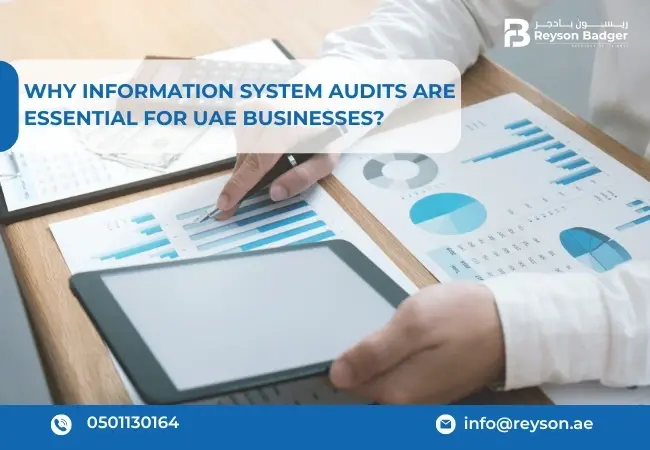
Learn why Information System Audits are crucial for UAE businesses, helping organizations strengthen cybersecurity, ensure regulatory compliance, and enhance overall IT efficiency.
Benefits of information system audit services in Dubai, UAE
- Reduced risk: Information system audits in the UAE address the risk of IT operations' integrity, availability, and confidentiality. The audit improves reliability by identifying and reducing a variety of risks.
- Secure data: Once risks have been identified, the company is free to redesign or fortify the insecure design, resulting in secure data.
- System evaluation: An IT audit will tell you if you're buying a proper system. This ensures that the system is effective and satisfies all of the goals.
- IT governance: An information system audit in the UAE guarantees compliance with all company laws and regulations by staff members and the IT department. This helps to improve IT governance and management.
Future Trends and Developments in Information System Audits
Impact of New Technologies
1. Artificial Intelligence and Machine Learning
AI and machine learning enhance audit efficiency by automating data analysis and detecting anomalies.
These technologies enable proactive audits, identifying potential issues before they escalate.
2. Blockchain Technology
Blockchain provides a secure, immutable ledger for transactions.
It improves transparency and reduces fraud by ensuring an unalterable audit trail.
3. Cloud Computing
The shift to cloud services introduces new challenges in data security and management.
Auditors will need to focus on cloud security and compliance with service providers’ policies.
4. Advanced Cybersecurity Tools
Evolving cyber threats require more sophisticated auditing techniques.
Continuous updates in cybersecurity tools will influence audit practices, focusing on enhanced defense measures.
Role of Information System Auditors
Information System Auditors evaluate an organization’s IT environment to ensure the confidentiality, integrity, and availability of data. In the UAE, Information System Auditors are responsible for:
- Assessing IT infrastructure and system architecture
- Evaluating cybersecurity frameworks and access controls
- Identifying IT risks and system vulnerabilities
- Verifying compliance with UAE data protection and cybersecurity regulations
- Recommending corrective actions and risk-mitigation strategies
By conducting independent and objective assessments, Information System Auditors help management make informed decisions and improve IT governance.
Challenges Faced by Information System Auditors
Information System Auditors often encounter challenges such as:
- Rapid technological advancements
- Complex cross-border data protection requirements
- Integration of legacy systems
- Evolving cybersecurity threats
- Resource and budget constraints within organizations
Professional Information System Auditors address these challenges through continuous learning and advanced audit methodologies.
Potential Changes in Regulatory Requirements and Standards
1. Evolving Data Protection Laws: Data protection regulations are constantly updated to address new privacy issues. Organizations must adapt their audit practices to comply with the latest legal requirements.
2. Stricter Cybersecurity Compliance: Improved security requirements may be imposed by regulators. Audits will increasingly focus on assessing and ensuring compliance with rigorous cybersecurity standards.
3. Global Harmonization of Standards: There is a push towards aligning information security standards globally. Multinational organizations will need to align audits with both local and international standards.
These trends and developments will shape the future of information system audits, driving greater efficiency, compliance, and alignment with evolving technological and regulatory landscapes.
Why choose us for Information System Auditors?
At Reyson Badger, our team of expert Information System Auditors offers a wide range of benefits while conducting Information System Audits in the UAE, including:
- Standardization: Ensuring consistent IT processes and procedures.
- Better Business Efficiency: Optimizing IT systems for smoother operations.
- System Process Control: Monitoring and improving workflows.
- Disaster Recovery & Contingency Planning: Preparing for unforeseen events.
Our Information System Auditors ensure that data generated by electronic systems is accurate, reliable, and can be used to make informed business decisions. Information System Audit services in UAE evaluate IT system controls and the overall IT environment to maintain trustworthiness and compliance.
With a highly qualified team, we conduct audits that reduce risks, identify vulnerabilities, and implement effective strategies for risk prevention. Protect your company’s critical information with Reyson Badger’s Information System Auditors.
Contact us today to safeguard your business with professional IT audit services in the UAE!
Audit
Auditing Services for Industries
- Auditing Services for Bakeries in Dubai
- Auditing Services for Butcheries in Dubai
- Auditing Services for Catering Services in Dubai
- Auditing Services for Clinics in Dubai
- Auditing Services for Event Management Companies in Dubai
- Auditing Services for Groceries in Dubai
- Auditing Services for Gym in Dubai
- Auditing Services for Health Club in Dubai
- Auditing Services for Hospital in Dubai
- Auditing Services for Legal Translation Company in Dubai
- Auditing Services for Management Consulting Companies in Dubai
- Auditing Services for Minimarts in Dubai
- Auditing Services for Owner's Association (Building Association Management) in Dubai
- Auditing Services for Printing Press in Dubai
- Auditors For Exhibition Companies


Latest Blogs

22
Jan
Accounts Outsourcing Services in Dubai: What Every Business Owner Should Know
Accounts Outsourcing Services in Dubai cover essential finance functions through a structured and professional workflow, compliant, and financially organized.
READ MORE →
19
Jan
VAT Impact on Company Profit in UAE: Key Factors Businesses Must Understand
Explore how VAT impacts company profit in the UAE, including compliance costs, pricing strategies, and the role of professional VAT services for businesses.
READ MORE →
19
Jan
Understanding VAT Refund Rules for Tourists in UAE Under FTA Guidelines
This guide explains VAT refund rules for tourists in the UAE, including eligibility, qualifying purchases, refund process, and key FTA guidelines to claim VAT refund in UAE.
READ MORE →
22
Jan
Why AML Checks Are More Important Than Ever in 2026?
Learn why AML compliance is vital in 2026. Avoid fines, protect your business, and meet new regulatory standards with strong AML checks.
READ MORE →
23
Jan
VAT Registration Threshold in UAE: Requirements, Calculation, and Compliance
READ MORE →
22
Jan
Amendment of the United Arab Emirates (UAE) VAT Decree-Law from 1st January 2026
UAE VAT Decree-Law amendments effective 2026 explained, including reverse charge updates, refund time limits, and enhanced FTA authority.
READ MORE →
19
Jan
Accounting Services in Dubai: A Practical Guide for Growing Companies
Accounting services in UAE, businesses gain clarity, confidence, and control over their finances allowing them to focus on what matters most: building and scaling their business in the UAE's competitive market.
READ MORE →
23
Jan
Corporate Tax Advance Pricing Agreements in the UAE
Advance Pricing Agreements (APAs) in the UAE help businesses obtain certainty on transfer pricing methods under the Corporate Tax regime. Learn how APAs work, eligibility criteria, benefits, and compliance requirements set by the UAE Federal Tax Authority
READ MORE →
23
Jan
UAE FTA Moves to Free Digital Tax Certificates: What It Means for Businesses?
The UAE FTA now offers free digital tax registration certificates with QR codes, eliminating paper fees and simplifying compliance for businesses.
READ MORE →
21
Jan
UAE FTA Removes Fees for Paper Tax Certificates, Moves to Free Digital Certificates
UAE Federal Tax Authority removes fees for paper tax certificates and introduces free digital certificates with QR codes from January 2026.
READ MORE →