VAT Impact on Company Profit in UAE: Key Factors Businesses Must Understand
19-Jan-2026
Tax Residency Certificate (TRC) in UAE
Tax Residency Certificate (TRC) in UAE
Tax Residency Certificate (TRC) in the UAE is a formal document issued by the Federal Tax Authority (FTA) that confirms an individual's or business's tax residency status in the country. It serves as proof that the bearer of the certificate is a resident of the UAE for tax purposes. To qualify for a Double Taxation Agreement, individuals must present a TRC proving their residency in another nation and taxation status. Government bodies, businesses, and individuals are eligible to benefit from the UAE's double taxation avoidance agreements by using the TRC certificate.

Tax Residency Certificate can be applied through the Federal Tax Authority’s web portal named EmaraTax Portal. Through this portal, we can apply for the Tax Residency Certificate and Commercial Activity Certificate.
Double Taxation Treaty

Double Taxation happens when similar taxes are imposed in two different countries on the same taxpayer and same taxable entity. This affects the goods, services, and technology transfer across the countries.
A double Taxation treaty has been implemented to avoid the double-taxation b/w countries with significant cross-border investments. The first Double Taxation Agreement was signed between UAE and France, the recent double Taxation Agreement was signed between UAE and Qatar. Currently, the UAE has signed 146 agreements between different countries to avoid double taxation. The Tax Residency Certificate is issued to take advantage of the Double Taxation Avoidance on income.
Double Taxation Avoidance Agreements, DTAA
Double Taxation Avoidance Agreements, DTAA, are treaties Founded between two or more countries to prevent the same income being taxed at the same time to an individual and his business. These DTAs are significant because they encourage cross-border trade and investment in a highly civilized manner by clearly allowing the ways of taxing income earned by a resident of another country in one country. Without DTAAs, a tax-payer would be subjected to a real challenge of paying tax on the same income in the country where it is earned and the country of residence that would significantly reduce his or her overall earnings.
DTAAs assist in deciding which country would be empowered to tax specific types of income such as dividends, royalties, interest, capital gains, and business profits. This is done by making available mechanisms like tax credits, exemptions, and reduced tax rates that prevent double taxation. They benefit individuals but also result in higher economic cooperation between two countries, ensuring international business is more feasible.
Here's the list of 146 Countries UAE has signed Double Taxation Agreement .
Benefits of a Tax Residency Certificate

Managing Double Taxation: TRC provides individuals and businesses with the opportunity to take advantage of Double Taxation Avoidance Agreements (DTAAs) the UAE has negotiated with different countries. As a result, the same income does not have to be taxed twice in two separate jurisdictions.
Strengthened Credibility: It is believed that having a tax residency certificate enhances an individual's or business' credibility in the eyes of foreign tax authorities, as it confirms that the individual or business is a tax resident in the UAE.
Reduced Withholding Taxes: In accordance with the relevant DTAA provisions, holders of TRCs can enjoy reduced withholding taxes on dividends, interest, royalties, and other income types.
Effectiveness of Tax Planning: People and companies may be able to structure and plan their tax obligations more effectively and lower the number of tax returns by utilizing a TRC.
Global Market Access: DTAAs give companies more competitive access to international markets, which lowers tax obligations and boosts profitability.
Law Adherence: Possessing a TRC guarantees adherence to global tax laws and assists you in avoiding legal issues related to tax residency and double taxation.
There are two types of Tax Residency Certificates:
- Tax Residency Certificate for Treaty Purposes
- Tax Residency Certificate for Domestic Purposes
Required Documents and Forms
TRC For Tax Treaty Purposes:
If the Applicant is a Natural Person
- Emirates ID (for verification, it must match the name on the card)
- Passport
- Valid Residence Permit
- Verified Copy of Residential Leasing Agreement
- Income Source/Salary Certificate
- Bank Statement issued by Local Bank (Should Cover 6 months within the financial year)
- FTA's or a local government agency's entry and exit report
- Permanent Place of Residence’s proof
- Electricity Bill or Cert. Lease Agreement (Should be under the name of the applicant)
- The title deed should be present if it is private propert
Source of Income:
- Self-employed individuals must present a trade license.
- If the property is leased, applicants who own it and receive money from it must present a lease agreement.
- Candidates who are retired should submit a statement to the FTA stating that they are making use of their personal funds and investments. Also, attach a supporting document.
- Provide a copy of the applicant's marriage license, proof of income, or salary certificate if they are being sponsored by their spouse.
If the Applicant is a Legal Person
- Authorised person's Emirates ID and Passport
- Trade License
- Memorandum of Association (MoA)
- Proof of Authorization (From MoA & PoA)
- A copy of the audited financial report produced by an authorized auditor or audit company (the application's stated start date of the fiscal year must match the financial audit report's coverage date).
- Certified Lease Agreement
- Upon request, a local bank will provide a bank issue statement covering the six months of the fiscal year.
If the Applicant is a Legal Person - Government Entity
- A copy of the trade license, government decision, or decree
- A Request letter by the Govt. Authority (Person)
TRC for Domestic Purposes
In accordance with Cabinet resolution number (27) for 2023
"If the Applicant is a Natural Person who has spent more than 183 days in the UAE"
- Passport (mandatory), Emirates ID, or UAE residence visa (if available).
- Entry and Exit Report from the Federal Authority of Identity and Citizenship or a Government entity with local competence.
If the Applicant is a Natural person who has spent less than 183 days but at least 90 days in the UAE
- Passport (mandatory), Emirates ID, or UAE residence visa (if available).
- Entry and Exit Report from the Federal Authority of Identity and Citizenship or a Government entity with local competence.
- Proof of income, salary certificate, proof of conducting business in the UAE, Proof of Permanent Residence: Title Deed, EJARI, Utility Bills, or Long-Term Rent Contract.
If the Applicant is a Natural Person who has spent less than 90 days in the UAE or falls under other situations
- Passport (mandatory), Emirates ID, or UAE residence visa (if available).
- Entry and Exit Report from Federal Authority of Identity and Citizenship.
- Proof of financial and personal interests: Consider occupation, familial and social relations, cultural activities, place of business, property management, and other relevant factors to determine if a person's financial and personal interests are centered in the UAE.
- Proof of permanent residence: Title Deed, EJARI, Utility Bills, or Long-Term Rent Contract.
Tax Residency Certificate (TRC) Eligibility Criteria
For Legal Persons
- In order to be eligible to apply for TRC, a legal entity must have been in existence for a minimum of one year.
- Financial statements are required to undergo an audit by a certified accounting firm.
- The report must be certified and stamped by the audit firm. The audited financial report must cover the financial year for which the certificate is required.
- The audit report for the previous year must be included if the certificate is requested for the current year.
- Must be engaged in a business activity in the UAE
For Natural Persons
- Must be primarily based in the United Arab Emirates, both in terms of residence and place of financial and personal interests.
- To qualify for tax residency under UAE’s double taxation agreements, a natural person must have been physically present in the UAE for 183 days or more during the requested 12-month period. For domestic purposes, a natural person may also qualify if present in the UAE for 90 to 182 days within the year, provided additional criteria outlined by the FTA are met.
- The application must include an annual leasing agreement that has been formally recorded by the appropriate authorities, such as the free zone authority, municipalities in other Emirates, or EJARI in Dubai.
How to Apply for a UAE Tax Residency Certificate
- Go to the FTA's EmaraTax Porta l first in order to receive a TRC Certificate.
- You may log in to EmaraTax if you already have an account; if not, please register a new account; alternatively, if your account is tied to the previous TRC Portal, please link it to the EmaraTax as well.
- Go to Other Services after logging in, then select Tax Residency Certificate from the dashboard. Then a query pops up asking if you are a registered taxpayer or not. Choose Yes if you are a registered taxpayer, and vice versa .
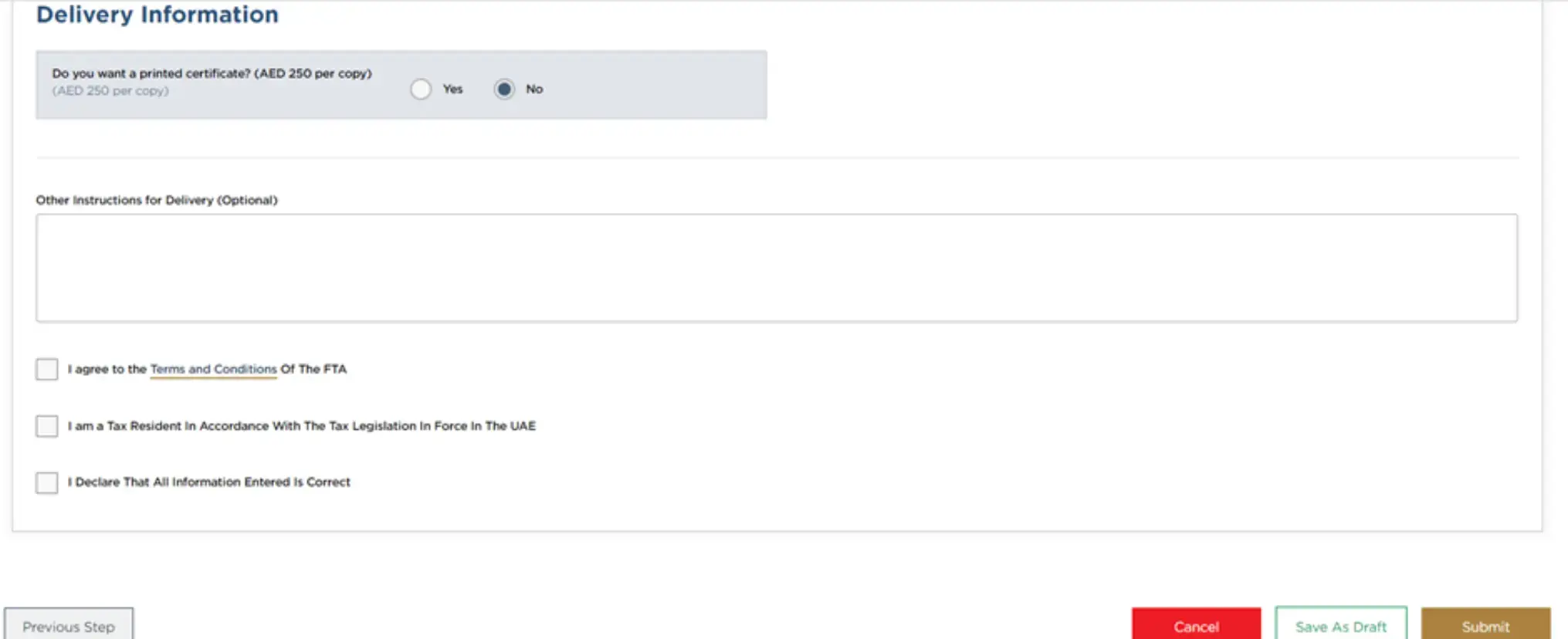
Please enter your Tax Registration Number and the Email Address you use to access e-services if you are a registered taxpayer. Alternatively, you can select "TRN Not Available" to continue.

- You will be directed to a new page where you can apply for the certificate if the information you have supplied matches.
Choose if "Domestic Purposes" or "Tax Treaty Purposes" require the TRC.
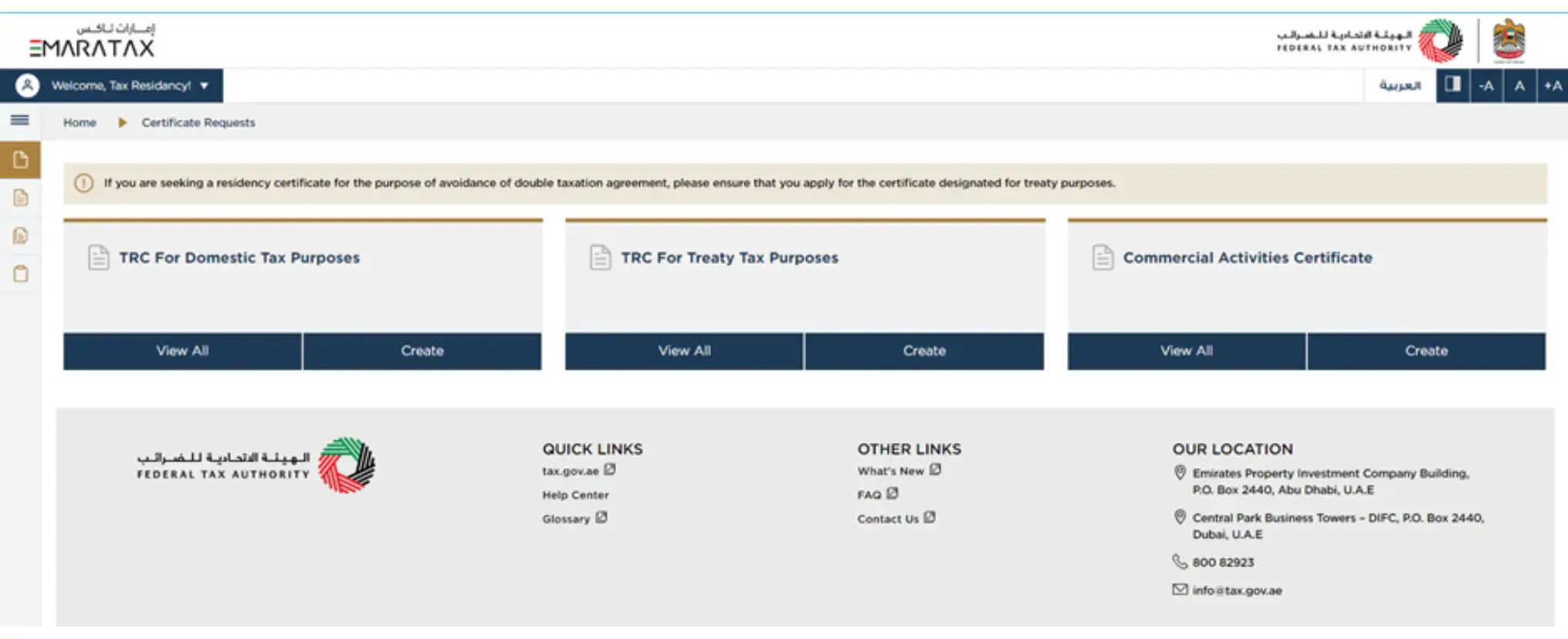
- If you are a legal person Select "Legal Persons " under "Application Type ", if you are a natural person Select "Natural Persons " under "Application Type ", if you are Legal Person Government Select "Legal Person Government " under "Application Type ".
- Enter the "TRN information (optional)" , if you are a legal person, enter the "Trade License Information "
- Select the country in which the certificate is to be issued.
- Decide which date should be shown on the certificate as the financial start date.
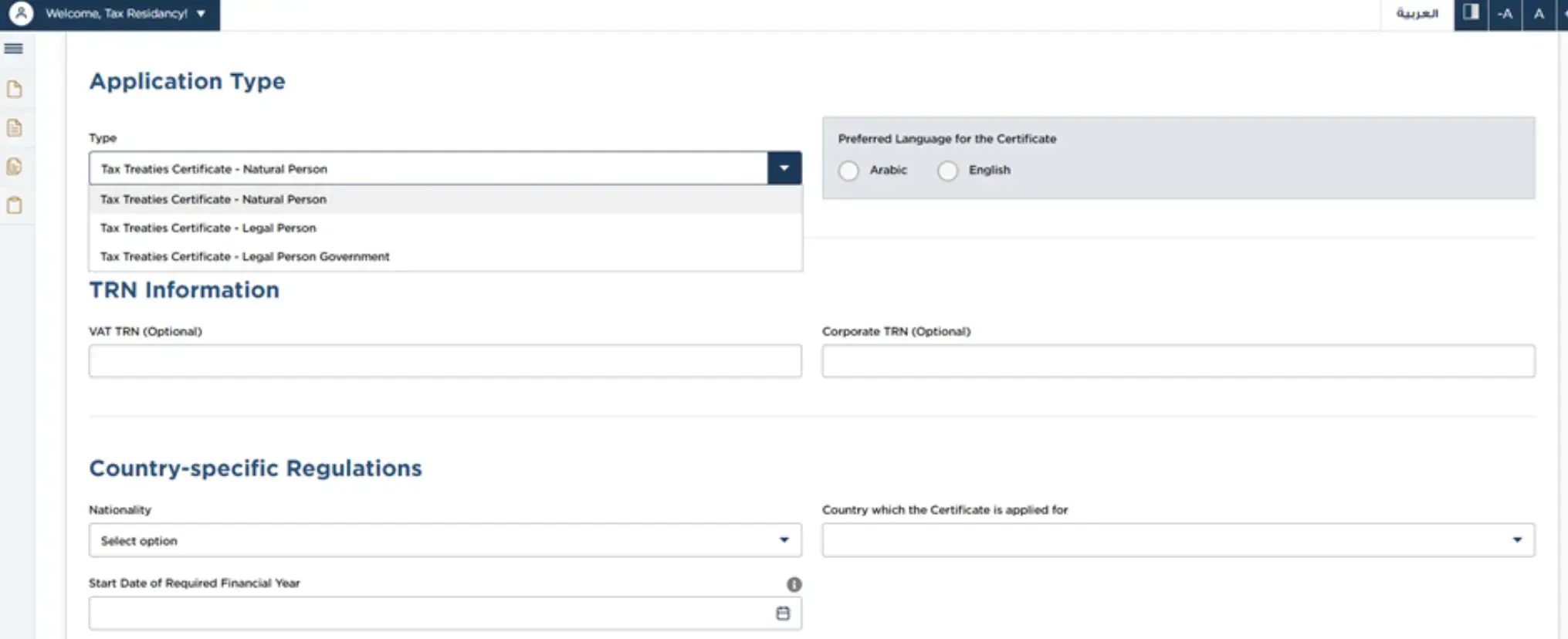
- Fill in all the Required Documents , and click the Submit button.
- Clicking the "next step" button brings up an information confirmation box.
It is important that you double-check all of the details as you will not be able to make any changes in the future.
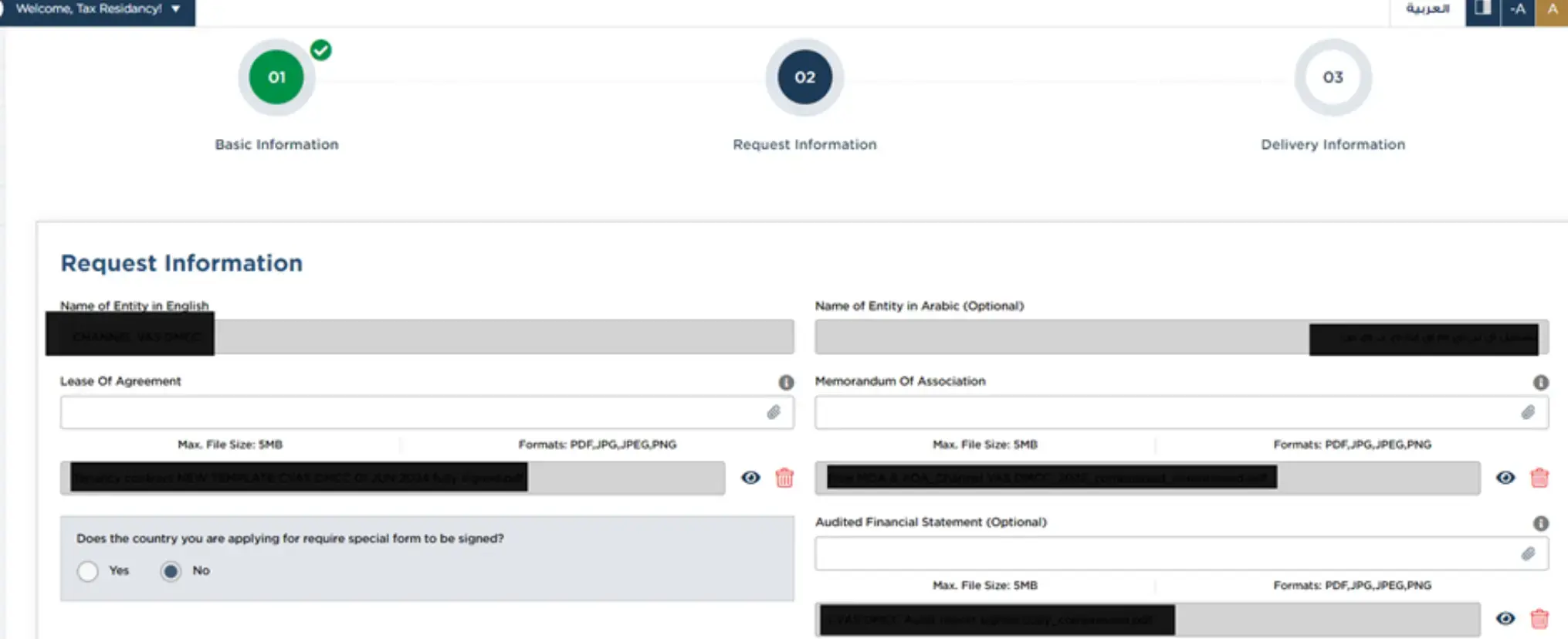
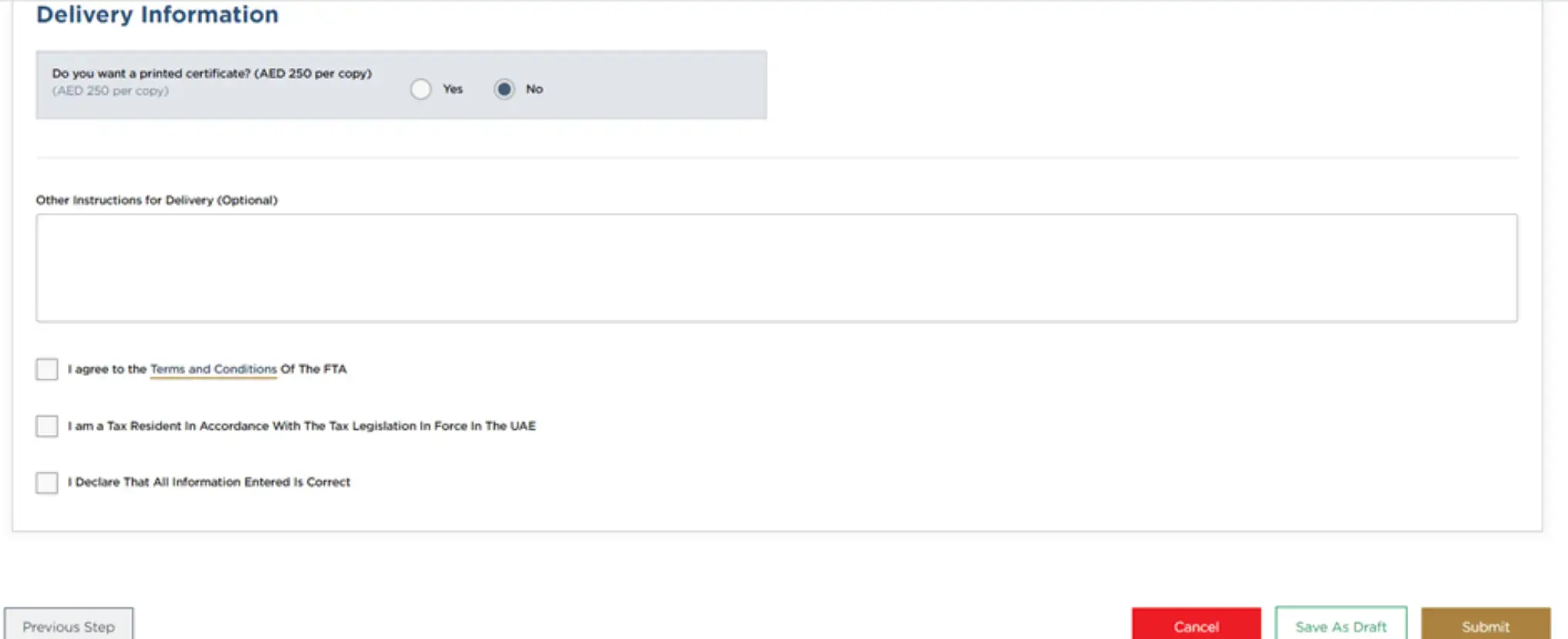
- If you require the hard copy certificate, check the "yes" box and provide the delivery details; if not, check the "no" box. Next, check the boxes (only if you self-declare to meet the prerequisites listed).
Tax Residency Certificate Cost in UAE
TRC Cost for Treaty Purpose
- Submission fee - AED 50
- Commercial Activity and Tax Registrants - AED 500
- Non-Tax-Registered Natural People - AED 1,000
- Non-Tax-Registered Legal People- AED 1,750
TRC Cost for Domestic Purpose
- Submission fee - AED 50
- Commercial Activity and Tax Registrants - AED 500
- Non-Tax-Registered Natural People - AED 1,000
- Non-Tax-Registered Legal People- AED 1,750
| Note: AED 250 will be added to the cost of the hard copy certificate. |
TRC Payment in UAE
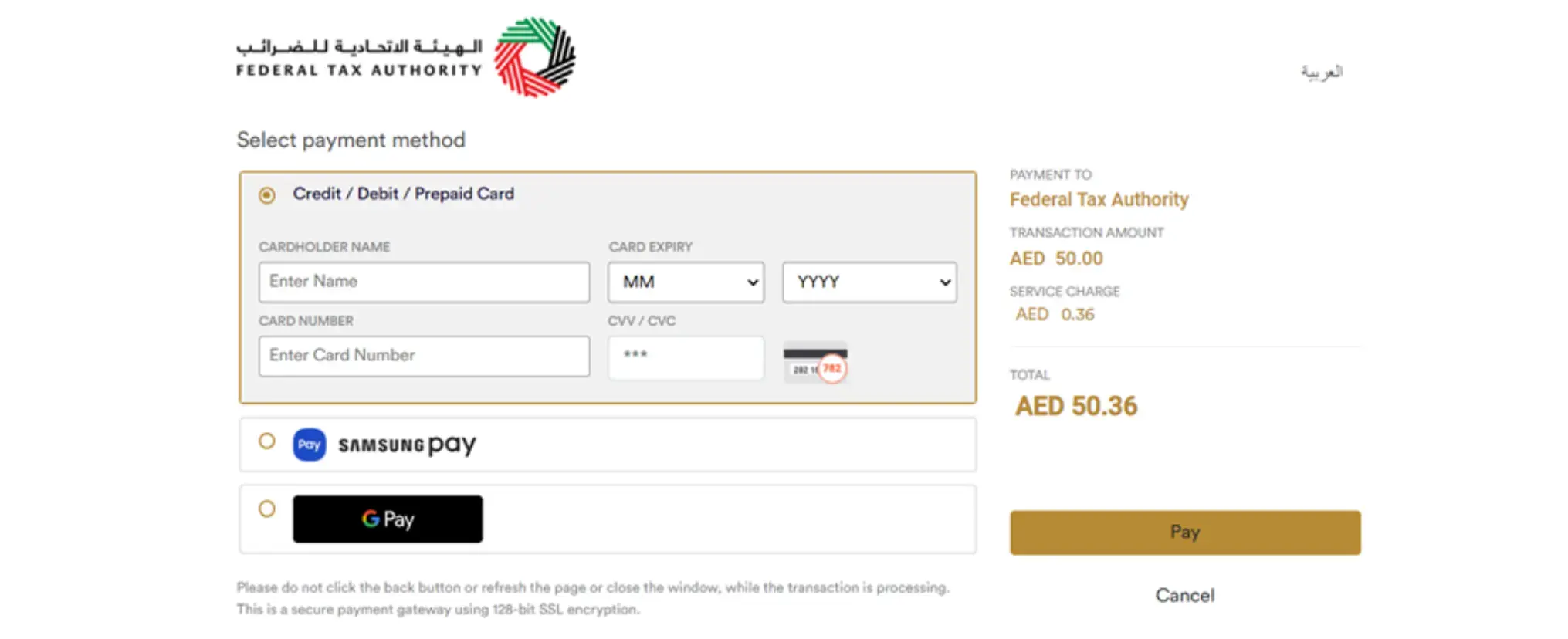
The payment gateway is the final step in the TRC Certificate download process. To download the certificate, you must first make a payment. You can use a credit or debit card, Google Pay, or Samsung Pay to make the payment.
TRC Validity in UAE
A Tax Residency Certificate (TRC) covers only the financial year selected in the application applicants must reapply if they require a certificate for a subsequent financial year, as the TRC is not automatically renewed beyond the selected year.
Duration for getting Tax Residency Certificate in UAE
It can take anywhere from a few weeks to a few months to receive a Tax Residency Certificate (TRC) after applying. The timing depends on how quickly the Federal Tax Authority processes your application. It also depends on whether they require further information or documents from you, as well as their current workload with other applications.
Tax Residency Certificate Eligible Countries
Certain countries in the UAE have agreed with the Double Taxation Agreement with UAE to avoid multiple taxation of taxes. In those countries with double taxation, individuals/businesses can show their Tax Residency Certificate to avoid multiple taxation. Here's a list of countries that have a Double Taxation Agreement with the UAE.
Tax Residency Certificate (TRC) Consultants in UAE
The Tax Residency Certificate (TRC) is extremely significant for individuals and enterprises dealing with taxes in many nations. It assists you in determining where you need to pay taxes, ensuring that you do not pay taxes twice on the same money. This accreditation also assists you in properly adhering to tax laws. Having a TRC expert, such as Reyson Badger , makes tax preparation easy.
Understanding your residency status under UAE's taxation agreements ensures compliance and maximizes tax benefits. The procedure of obtaining a TRC, as well as the length of time it takes, demonstrate its importance in tax management and economic growth. Working with Tax Residency Certificate (TRC) specialists in the UAE improves tax management, enhances international business, and boosts global economic success.
Tax Residency Certificates
Here is a Tax Residency Certificate for a Legal Person in the UAE
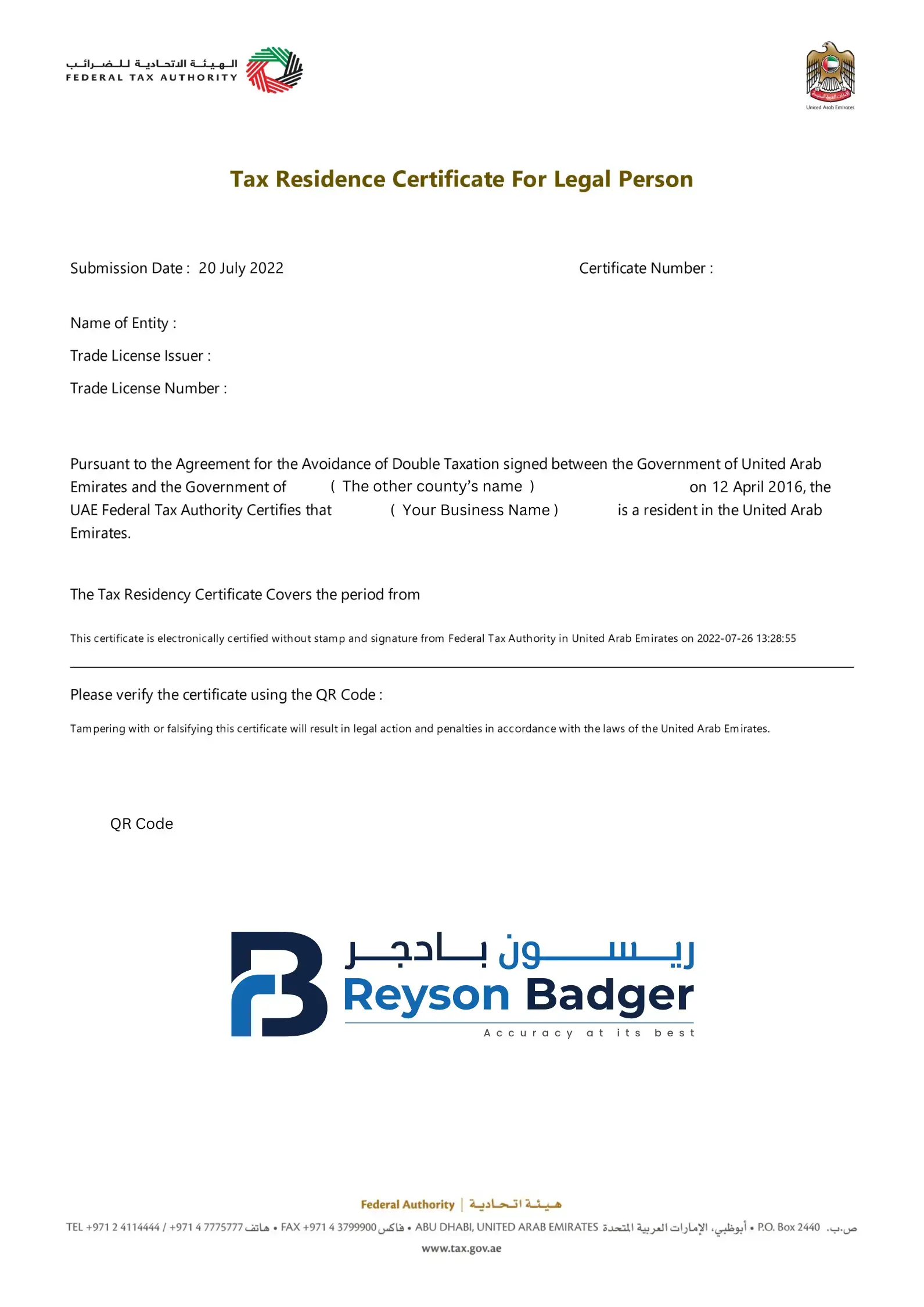
The Tax Residency Certificate for Legal persons consists of the following details:
- Federal Tax Authority logo
- Certificate number
- Submission Date
- Name of Entity
- Trade License Issuer
- Trade License Number
- Tax Treaty between the two Governments
- Certificate validity Period
- Certificate Validity QR Code
Here is a Tax Residency Certificate for a Natural Person in the UAE
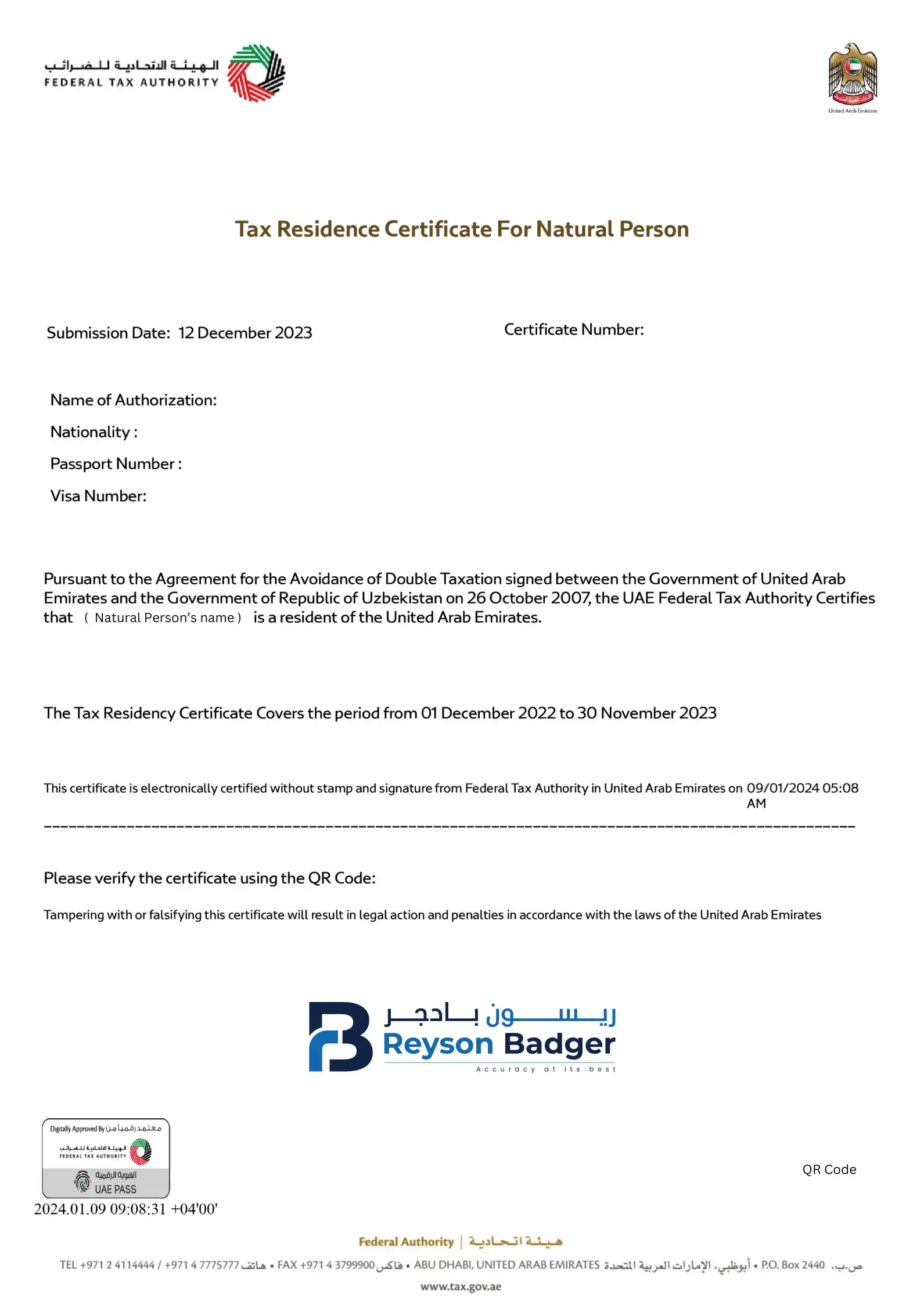
The Tax Residency Certificate for Natural Persons consists of the following details:
- Federal Tax Authority Logo
- Certificate Number
- Submission Date
- Name of the Individual
- Nationality
- Passport Number
- Visa Number
- Tax Treaty between Governments
- Certificate Validity Period
- Certificate Validity QR Code
Here are the other VAT Services Reyson Badger provides
| VAT Registration | VAT Reclaim |
| Excise Tax Registration | VAT De-Registration |
| VAT Return Filing | VAT Refund Services |
| Excise Tax Advisory | ESR Notification & Reporting |
VAT
Tax Consultant Services for Industries
- Tax Consultant Services for Insurance in UAE
- Tax Consultant Services for Event Management in UAE
- Tax Consultant Services for Manufacturing Industry in UAE
- Tax Consultant Services for Marine Industry in UAE
- Tax Consultant Services for Oil and Gas in UAE
- Tax Consultant Services for Real Estate in UAE
- Tax Consultant Services for Restaurants in UAE
- Tax Consultant Services for E-Commerce in UAE
- Tax Consultant Services for Logistics & Transportation in UAE
- Tax Consultant Services for Technology in UAE
- Tax Consultant Services for the Construction Industry
- Tax Consultant Services for Healthcare in UAE
- Tax Consultant Services for the Education Industry in UAE
- Tax Consultant Services for Retail and Wholesale Trade
- Tax Consultant Services for Automotive Industry
- Tax Consultant Services for Hospitality and Tourism in UAE






Latest Blogs

22
Jan
Accounts Outsourcing Services in Dubai: What Every Business Owner Should Know
Accounts Outsourcing Services in Dubai cover essential finance functions through a structured and professional workflow, compliant, and financially organized.
READ MORE →
19
Jan
VAT Impact on Company Profit in UAE: Key Factors Businesses Must Understand
Explore how VAT impacts company profit in the UAE, including compliance costs, pricing strategies, and the role of professional VAT services for businesses.
READ MORE →
19
Jan
Understanding VAT Refund Rules for Tourists in UAE Under FTA Guidelines
This guide explains VAT refund rules for tourists in the UAE, including eligibility, qualifying purchases, refund process, and key FTA guidelines to claim VAT refund in UAE.
READ MORE →
22
Jan
Why AML Checks Are More Important Than Ever in 2026?
Learn why AML compliance is vital in 2026. Avoid fines, protect your business, and meet new regulatory standards with strong AML checks.
READ MORE →
23
Jan
VAT Registration Threshold in UAE: Requirements, Calculation, and Compliance
READ MORE →
22
Jan
Amendment of the United Arab Emirates (UAE) VAT Decree-Law from 1st January 2026
UAE VAT Decree-Law amendments effective 2026 explained, including reverse charge updates, refund time limits, and enhanced FTA authority.
READ MORE →
19
Jan
Accounting Services in Dubai: A Practical Guide for Growing Companies
Accounting services in UAE, businesses gain clarity, confidence, and control over their finances allowing them to focus on what matters most: building and scaling their business in the UAE's competitive market.
READ MORE →
23
Jan
Corporate Tax Advance Pricing Agreements in the UAE
Advance Pricing Agreements (APAs) in the UAE help businesses obtain certainty on transfer pricing methods under the Corporate Tax regime. Learn how APAs work, eligibility criteria, benefits, and compliance requirements set by the UAE Federal Tax Authority
READ MORE →
23
Jan
UAE FTA Moves to Free Digital Tax Certificates: What It Means for Businesses?
The UAE FTA now offers free digital tax registration certificates with QR codes, eliminating paper fees and simplifying compliance for businesses.
READ MORE →
21
Jan
UAE FTA Removes Fees for Paper Tax Certificates, Moves to Free Digital Certificates
UAE Federal Tax Authority removes fees for paper tax certificates and introduces free digital certificates with QR codes from January 2026.
READ MORE →