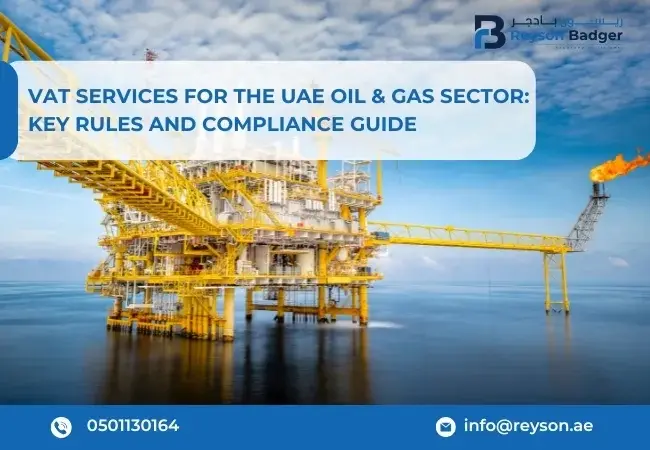


The UAE’s oil and gas sector operates within one of the most sophisticated tax frameworks in the region. With the introduction of VAT under Federal Decree-Law No. 8 of 2017, businesses engaged in exploration, extraction, refining, processing, transportation, and trading must comply with strict VAT classification and reporting obligations.
Accurate classification especially between zero-rated supplies (such as crude oil) and standard-rated supplies (such as refined products) is essential for preventing costly errors, denied input VAT recovery, and significant penalties.
Given the scale of transactions and complex supply chain structures, companies increasingly rely on professional VAT services in Dubai and the UAE. Reyson Badger’s tax specialists ensure that classification, documentation, reverse charge application, and filings are fully compliant, reducing risks and strengthening overall tax governance.
VAT Basics for Oil & Gas in the UAE
The standard VAT rate in the UAE is 5%, applicable to most goods and services. However, Article 45(11) of the UAE VAT Law provides a special zero-rating provision for crude products.
VAT Treatment Overview
| Product Type | VAT Rate | Description |
|---|---|---|
| Crude Oil & Unrefined Natural Gas | 0% | Zero-rated local supplies and exports as per UAE VAT Law Article 45(11) |
| Refined Oil & Petroleum Products | 5% | Standard VAT applies, including fuel sold at petrol stations |
This distinction is foundational misclassification leads to incorrect VAT reporting, mismatched invoices, and rejected refund claims.
When Oil & Gas Supplies Are Zero-Rated vs Standard-Rated?
Understanding when supplies qualify for zero-rating versus standard-rating is essential for regulatory compliance and accurate financial reporting.
Zero-Rated Supplies (0%)
Zero-rating applies when:
- The product is crude oil or unrefined natural gas.
- Supplies are made within the UAE to registered businesses.
- Crude products are exported outside the UAE, subject to proper customs verification.
- Transactions comply with Article 45 and require complete supporting documentation.
Zero-rated supplies still require VAT invoices but tax is charged at 0%, enabling companies to recover input VAT fully.
Standard-Rated Supplies (5%)
Standard VAT applies to:
- Refined petroleum products (e.g., petrol, diesel, kerosene).
- Natural gas that has undergone processing.
- Lubricants, petrochemicals, LNG, LPG, and similar non-crude outputs.
- Fuel sold at retail stations.
- Storage, distribution, refinery services, and transportation services.
Incorrectly treating refined or processed petroleum as zero-rated is one of the most common VAT violations in the UAE oil and gas sector.
Importance of Correct VAT Classification
Accurate VAT classification has a direct impact on:
- Compliance with UAE VAT regulations
- Input VAT recovery eligibility
- Correct application of reverse charge mechanism
- Timely VAT refunds
- Audit readiness
- Avoidance of penalties, interest, and re-assessments
Penalties for incorrect classification may include:
- AED 10,000 for incorrect tax invoice format
- 2% of unpaid VAT per month
- Retrospective VAT assessments for up to 5 years
VAT Compliance Challenges in the UAE Oil & Gas Sector
The oil and gas value chain is uniquely complex. It spans upstream, midstream, and downstream activities each with distinct VAT implications, supply rules, and documentation requirements.
1.Complex Supply Chain and Multi-Rate Classification
Every stage may involve a mix of zero-rated, exempt, and standard-rated elements:
- Upstream: exploration, drilling, extraction (zero-rated crude output but standard-rated services)
- Midstream: pipelines, transportation, storage (primarily standard-rated services)
- Downstream: refining, retail, distribution (standard-rated supplies)
Failure to classify transactions by supply chain stage creates inconsistent VAT returns and audit discrepancies.
2.Reverse Charge Mechanism (RCM)
The Reverse Charge Mechanism is extensively used in the oil and gas sector due to the nature of domestic and cross-border hydrocarbon supplies.
RCM applies when:
- A UAE-registered recipient purchases hydrocarbons from a domestic or GCC supplier.
- Certain imported services relating to the oil and gas industry are purchased from overseas vendors.
- Supplies fall under Article 48(3) and related executive regulations.
The recipient must self-account for VAT, increasing the risk of accounting errors without expert oversight.
3.Export Compliance and Documentation
Exports of crude oil often qualify for zero-rating, but require:
- Customs export declarations
- Shipping documents (BL/AWB)
- Proof of overseas customer VAT status
- Payment confirmations
- Export verification within 90 days
Missing documents can cause the FTA to reject zero-rating and impose VAT liabilities at 5%.
4.Impact on Cash Flow and VAT Refunds
Oil and gas companies frequently incur substantial capital expenditures (CAPEX), making them eligible for significant VAT refunds.
Common refund challenges include:
- Delayed validation due to high transaction volumes
- Inaccurate classification of zero-rated supplies
- Insufficient documentation
- Errors in RCM calculations
- Mismatched invoice details (TRN, address, supply date)
Efficient VAT refund management is critical to ensuring liquidity and preventing cash flow disruptions.
Why Oil & Gas Businesses in the UAE Should Use Professional VAT Services?
Given the industry’s scale, complexity, and strict regulatory oversight, specialized VAT support is essential.
- Proper differentiation between crude and non-crude products
- Correct application of 0% and 5% VAT
- Reliable VAT reporting in line with UAE VAT Law and Executive Regulations
- Avoidance of misreporting penalties
- Preparation for FTA audits and inspections
Efficient Handling of Reverse Charge Obligations
Professionals ensure:
- Correct RCM calculations
- Accurate VAT treatment of domestic and cross-border hydrocarbon supplies
- Prevention of double taxation or underreporting
- Alignment with Article 48 requirements
Optimizing VAT Refunds and Strengthening Cash Flow
VAT consultants:
- Prepare and validate refund claims
- Ensure documentation compliance
- Follow up with the FTA for status and clarifications
- Help businesses forecast refund cycles
- Identify recoverable input VAT not captured by internal teams
Local Expertise in UAE and Multi-Emirate Regulations
A UAE-based VAT consultancy provides:
- Knowledge of free zone vs mainland VAT implications
- Awareness of local regulatory variations (Dubai, Abu Dhabi, Sharjah)
- Sector-specific expertise in oilfield services, upstream contractors, and refiners
- Real-time updates on legislative changes
Conclusion
Navigating VAT in the UAE’s oil and gas sector requires a precise understanding of product classification, zero-rating provisions, reverse charge rules, and supply chain-specific VAT treatments. With penalties for misclassification and non-compliance becoming increasingly strict, businesses need robust tax governance frameworks.
Reyson Badger provides end-to-end VAT support tailored to oil and gas operations from classification and compliance to refund optimization and audit readiness. Our expert team ensures accurate reporting, regulatory alignment, and financial efficiency across all stages of your operations.